Too many systems
Assessment staff used up to five systems to complete one assessment. Administrative staff used up to four systems to review documents for one applicant.
I led end-to-end UX for a fully launched workflow redesign that simplified document handling for administrative and assessment staff, reduced manual effort, and created a stronger foundation for application and document integration.
The Ministry received supporting documents through online upload, email, fax, and mail. Administrative staff had to retrieve, review, store, match, and record documents across several systems before assessment staff could complete an eligibility decision.
A policy change increased document volume while the legacy system was slow and nearing end of life. The design challenge was to improve a service connecting citizens, frontline staff, assessors, policy requirements, and internal systems.
I supported discovery research and stakeholder workshops, informed by internal performance data. I then conducted iterative usability testing as workflows, interface designs, and features evolved, followed by post-launch testing in the live system.
Assessment staff used up to five systems to complete one assessment. Administrative staff used up to four systems to review documents for one applicant.
Documents arrived through several channels, then required retrieval, completeness checks, storage, metadata entry, matching, and preparation for assessment.
Applicants often struggled to find where to upload supporting documents after submitting an application.
CRA consent was critical, but its review process did not clearly reflect the policy requirement.
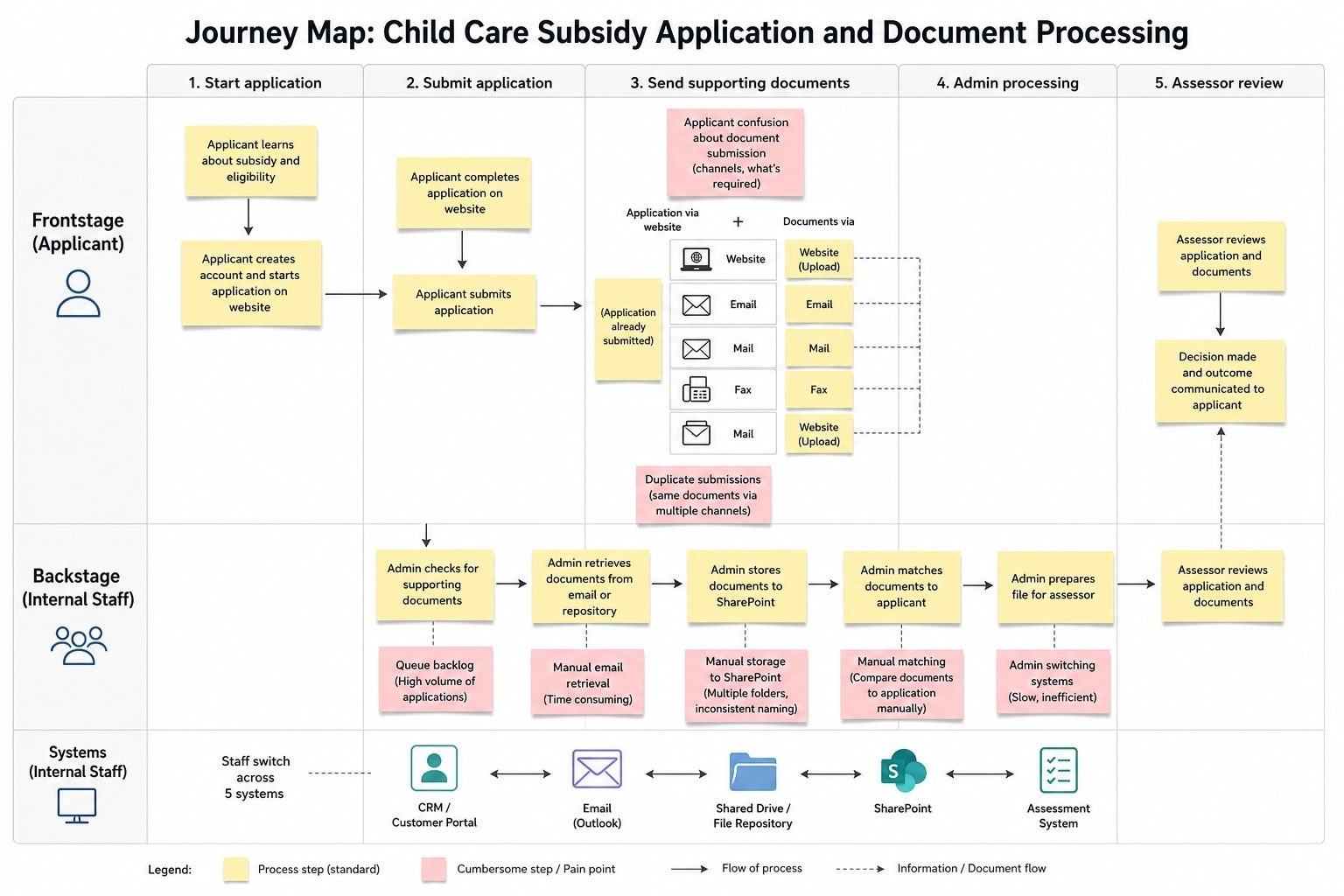
1. Redesign the end-to-end workflow. Workflow artifacts and a co-created service blueprint established a shared picture of manual retrieval, matching, storage, and system switching.
2. Prioritize document-to-application association. The first release linked documents to relevant applications and clarified review work. Applicant-level association and versioning remained a future-state concept due to technical constraints.
3. Create a policy-enabled path to digital CRA consent. Policy approval for MADI-verified digital consent became a separate follow-on project.
The workflow simplified document-review activities, reduced manual steps, and lowered the effort required to locate, associate, and review supporting documents. Qualitative observation and user validation indicated an estimated 60–80% improvement in documentation-review efficiency across relevant activities.
The protected case study includes workflow artifacts, annotated product screens, design-to-delivery documentation, validation evidence, and the full decision narrative.
Open protected case study →